How a Mobile Game Studio Turned Competitor Ad Research Into a Live Daily Feed
A 50-person studio stopped guessing what rivals were testing — and started seeing every new ad the day it launched.
Mindra connected three ad libraries — Meta, TikTok, and Google — into one research agent that pulls every competitor's new and active ads each morning, tags them by hook and spend, and posts a digest to Slack. A studio that used to notice a rival's new creative two to three weeks late now sees it the same day.
Key takeaways
- Competitor ad research was a part-time job nobody owned. Someone scrolled Meta Ad Library for 20 minutes on a Friday, screenshotted a few ads, and moved on. TikTok and Google got checked even less.
- Mindra's built-in Ad Creative Researcher agent went live on day one. No engineers. The first competitor digest landed within minutes of the first prompt.
- One agent now watches 20+ competitors across four ad networks continuously, has indexed and tagged 3,800+ creatives, and ships a hook-pattern report every week on its own.
- Detection time collapsed from 2–3 weeks to same day. When a rival ramps spend on a new test, the creative team sees a one-page briefing without asking for it.
- The studio built a real research memory — first-seen and last-seen dates for every creative — so it can answer questions like "has any competitor tried a UGC unboxing format before?"
- What's next: weighing which tests actually scale, plus connecting the studio's own ad accounts to compare its hooks against competitors in the same week.
What problem was the studio actually trying to solve?
The studio makes mobile games. Fifty people. In their world, the ad creative is the product pitch — a three-second hook decides whether someone installs. Knowing what's working for competitors isn't a nice-to-have. It's the job.
But competitor research had quietly become nobody's job. It worked like this: on a slow Friday, someone would open Meta Ad Library, scroll for twenty minutes, screenshot a few interesting ads into Slack, and get back to real work. TikTok Creative Center got a look maybe once a fortnight. Google Ads Transparency Center, almost never.
The cost showed up on a delay. By the time anyone noticed a competitor had shifted to a new hook style — say, swapping polished gameplay clips for raw creator UGC — that ad had been running for two or three weeks. Which, in mobile user acquisition, means it had already been converting for two or three weeks. The studio was reacting to trends that were nearly over. They were always one cycle behind.
The problem wasn't laziness. It was that manual research doesn't scale. You can watch one competitor by hand. You cannot watch twenty across four platforms, every day, and still ship creative.
What did the studio set up, and how long did it take?
They activated Mindra's built-in Ad Creative Researcher agent.
Quick plain-language detour, because "agent" gets thrown around loosely. An AI agent in Mindra is less like a chatbot and more like a coworker you hire with a sentence. It connects to your tools, reads data, takes actions, runs on a schedule, and remembers what it learned. You tell it what you want in plain English. It does the work and reports back. No code.
The Ad Creative Researcher is one Mindra ships pre-configured for exactly this. Out of the box it can search for brands, pull a brand's full ad history, retrieve active and past ads, find related brands and ads, detect duplicate creatives running across multiple accounts, and check page-level analytics and ad usage. Think of it as a research analyst who already knows how every major ad library works and never gets bored.
The studio connected five tools: Meta Ad Library, TikTok Creative Center, Google Ads Transparency Center, Slack, and Notion. Setup needed no engineers.
Then they did one smart thing before the first prompt: they saved a hook taxonomy to the agent's memory. A "hook" is the opening idea that grabs a viewer — the thing that makes someone stop scrolling. They defined five buckets: pain-point, FOMO, social proof, "satisfying gameplay," and UGC-testimonial. By writing this taxonomy into memory once, every ad the agent ever pulls gets tagged the same way, consistently, forever. No drift. No two people labeling the same ad differently.
Time to value: day one. The first competitor digest was delivered the same day they switched it on.
What did the first prompt look like?
They didn't write a spec. They wrote a sentence to a coworker:
Every morning, pull new and actively-running ads from our competitor list across all three platforms. Tag each by hook type, format, and estimated spend tier. Flag anything that looks like a new test — a hook or format we haven't seen from that competitor before.
Mindra returned a tagged breakdown within minutes. It flagged four ads as "likely new test" — not by guessing, but by reading the signals: launch dates clustering together and impressions ramping the way a fresh test ramps. That's the kind of pattern a human notices only after staring at a library for weeks. The agent caught it on the first pass.
What does a daily digest actually look like?
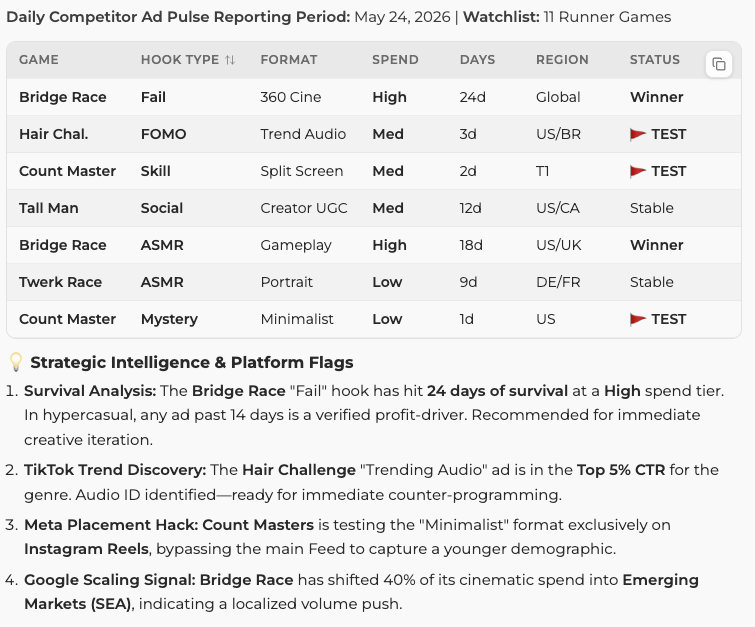 What lands in Slack at 8am: Mindra's Daily Competitor Ad Pulse, with each competitor creative tagged and flagged.
Here's a sample of the Daily Competitor Ad Pulse — illustrative, in the agent's standard format. This run is dated May 24, 2026, across a watchlist of 11 runner games.
| Competitor | Hook | Format | Spend | In Market | Region | Status |
|---|---|---|---|---|---|---|
| Bridge Race | Fail | 360 Cine | High | 24d | Global | Winner |
| Hair Chal. | FOMO | Trend Audio | Med | 3d | US/BR | TEST |
| Count Master | Skill | Split Screen | Med | 2d | T1 | TEST |
| Tall Man | Social | Creator UGC | Med | 12d | US/CA | Stable |
| Bridge Race | ASMR | Gameplay | High | 18d | US/UK | Winner |
| Twerk Race | ASMR | Portrait | Low | 9d | DE/FR | Stable |
| Count Master | Mystery | Minimalist | Low | 1d | US | TEST |
A table is useful. But the studio's creative leads don't read tables — they read the flags. Underneath, Mindra adds a short strategic read:
- Survival analysis: Bridge Race's "Fail" hook has survived 24 days at high spend. Past the 14-day mark, a creative is a verified profit-driver, not a guess. This one is real.
- TikTok trend discovery: Hair Challenge's "Trending Audio" ad is in the top 5% for CTR. The agent identified the specific audio ID driving it.
- Meta placement hack: Count Masters is testing its "Minimalist" format exclusively on Instagram Reels — a placement-level move easy to miss by eye.
- Google scaling signal: Bridge Race shifted 40% of its cinematic spend into emerging markets in Southeast Asia.
That's the difference between a list of ads and intelligence. The agent isn't just collecting — it's telling you which threads to pull.
What did Mindra build on top of the daily pulse?
The daily digest was the start. Because the agent runs on a schedule and keeps a memory, it compounded into a small research system — four standing jobs that run with no one asking.
1. The daily impressions sweep. Every morning the agent re-pulls active creatives, compares them against yesterday's index, and flags anything new. Each new ad gets auto-tagged by hook and routed to a #competitor-watch Slack channel — with thumbnails. The Friday-afternoon scroll is gone. The studio wakes up to it.
2. The weekly hook-pattern report. Once a week the agent clusters all 3,800+ indexed creatives by hook archetype and surfaces the trend lines: which patterns are scaling up, and which are being quietly pulled down fast. (When a competitor kills a creative fast, that's a signal too — it tells you what didn't work, on someone else's budget.)
3. The launch-window briefing. When a competitor ramps spend on a new creative — detected through jumps in the impression range — Mindra compiles a one-page briefing into Slack automatically. The creative itself, the hook breakdown, an estimate of how long it's been in market, and a side-by-side against the studio's current top performers. No one requests it. It just appears when it matters.
4. The quarterly portfolio map. Once a quarter the agent runs a clustering pass across the entire library to map where each competitor concentrates its creative investment by genre mechanic — match-3 versus board-building versus narrative. It's the strategic, zoomed-out view: not "what ad ran today" but "where is this rival placing its bets."
Here's the kind of message that lands in Slack on its own when a briefing triggers:
🚨 New launch detected — Count Master A "Minimalist" creative just jumped from ~Low to Med spend, Instagram Reels only, US. • Hook: Mystery (new for this competitor — first seen 1 day ago) • Format: Minimalist, portrait • Time in market: ~24 hours • vs. your top performer: Your best Reels creative this week is a "Satisfying Gameplay" hook. This is a different lever — worth a test. Full breakdown saved to Notion.
Why did this work when manual research didn't?
Three reasons, and none of them are "the AI is smart."
It caught tests on day one, not week three. The whole value of competitor intelligence is timing. A trend you spot after it peaks is trivia. A trend you spot as it's launching is an edge. Moving detection from weeks to same-day is the entire ballgame.
It built a real history. Because every creative gets a first-seen and last-seen date, the studio now has institutional memory it never had before. Someone can ask, "Has any competitor tried a UGC unboxing format before, and how long did it last?" — and get an answer from data, not from whoever happened to be scrolling that month. People leave; the memory stays.
It briefs the creative team automatically. The weekly report isn't a dashboard someone has to remember to open. It arrives as a creative brief with reference ads attached. Research stopped being a separate task and became an input the creative team gets for free.
What changed — the before-and-after
| Before Mindra | After Mindra | |
|---|---|---|
| Who did research | Whoever had a free Friday | A standing agent, 24/7 |
| Coverage | Mostly Meta, occasional TikTok | Meta + TikTok + Google + ongoing index |
| Competitors watched | A handful, inconsistently | 20+ continuously |
| Creatives tracked | Screenshots in Slack | 3,800+ indexed and tagged |
| Tagging | Ad hoc, inconsistent | One fixed taxonomy, every ad |
| Time to spot a new test | 2–3 weeks | Same day |
| Reports | Whenever someone made one | Weekly, automatic |
What's the scoreboard?
- 20+ competitors monitored continuously across 4 ad networks.
- 3,800+ creatives indexed and tagged against a consistent hook taxonomy.
- 1 hook-pattern report shipped every week, automatically.
- Detection time: down from 2–3 weeks to same day for any competitor's new test.
What is the studio doing next?
Two upgrades are in motion.
First, impression-share estimation — so the agent doesn't just flag that a test exists, but weights which tests are actually scaling. Lots of ads launch; few become winners. The studio wants the agent to tell them where the real momentum is, not just where there's motion.
Second, connecting their own data — their Looker dashboard plus their own Meta and TikTok ad accounts. Once Mindra can see the studio's own CTR and hook performance, it can compare the studio directly against competitors in the same week. Not "here's what they're doing" but "here's what they're doing, and here's exactly where you're winning or losing against it."
Frequently asked questions
How can I track competitor ads automatically? Connect your ad libraries — Meta Ad Library, TikTok Creative Center, Google Ads Transparency Center — to an AI agent and tell it, in plain English, to pull new and active competitor ads on a schedule. With Mindra, the studio in this case study set this up in a day with no engineers. The agent re-pulls every morning, diffs against yesterday, tags each ad, and posts new ones to Slack — so tracking happens continuously instead of whenever someone has a free afternoon.
What is an ad creative researcher agent? It's an AI agent pre-configured to research ad creatives and brand intelligence across ad platforms. It can search for brands, pull a brand's full ad history, retrieve active and past ads, find related brands, detect duplicate creatives across accounts, and check page-level ad usage. Think of it as a research analyst who already knows how every ad library works, runs on a schedule, and remembers what it learned. Mindra ships one built in.
How do you monitor Meta Ad Library, TikTok Creative Center, and Google Ads Transparency at once? You connect all three to a single agent rather than checking each by hand. The agent unifies them: one daily pull, one consistent set of tags, one digest. In this case study, the studio went from mostly checking Meta — with TikTok and Google barely covered — to watching 20+ competitors across all four ad networks every day, with 3,800+ creatives indexed.
How does Mindra detect when a competitor launches a new ad test? Mindra reads the patterns a human would only catch after weeks of staring: launch dates clustering together and impressions ramping the way a fresh test ramps. When spend jumps on a new creative, it compiles a one-page launch-window briefing — the creative, its hook breakdown, time in market, and a side-by-side against your current top performers — and drops it in Slack automatically. The studio's detection time fell from 2–3 weeks to same day.
Do I need engineers to set this up? No. Mindra's agents are configured in plain language — you describe what you want, like writing a message to a coworker, and the agent does the rest. The studio in this case study activated the built-in researcher, connected its tools, and saved a hook taxonomy to memory without writing code. The first competitor digest arrived on day one.
Is competitor ad research data handled securely? Yes. Mindra is SOC 2 Type II certified and GDPR compliant, with role-based access control (RBAC), single sign-on (SSO), a full audit trail, and human-in-the-loop approvals for sensitive actions. Zero Data Retention is available, and Mindra is model-agnostic — you can run agents on Claude, Gemini, GLM, Qwen, or DeepSeek.
Where Mindra fits
Most teams don't lack the will to watch competitors. They lack the hours. Manual research scales to one competitor on a good week — never to twenty across four platforms, every day, while still shipping creative. Mindra closes that gap by letting you hire a whole department of AI agents with a single sentence: agents that connect to your tools (3,000+ integrations), read your data, take actions, run on a schedule, and keep a memory — with human approvals and a full audit trail when you need them.
This studio turned an occasional Friday chore into a live daily feed. Whatever your version of "the research nobody has time for" is, an agent can probably own it.
Explore more in the case studies hub, or see how teams put agents to work elsewhere:

Zeynep Yorulmaz
CEO of Mindra
Zeynep Yorulmaz is the Co-Founder & CEO of Mindra, building the platform that lets any team hire a whole department of AI agents with a single prompt.
Stay Updated
Get the latest articles on AI orchestration, multi-agent systems, and automation delivered to your inbox.
Mindra field guide
Read next
Related Articles
How a Food Delivery Platform Runs Ops for 3,000+ Restaurant Partners With AI Agents
A national food delivery platform used AI agents to flag failing restaurant partners two weeks early, catch a leaked coupon code in week one, and triage urgent support tickets in minutes.
How a Fintech Cut First-Response Time From 6 Hours to 4 Minutes — Without Lowering the Compliance Bar
A five-person support team was buried in tickets mixing routine questions with sensitive ones. By building an AI support agent around guardrails first, this fintech hit 4-minute first responses and zero compliance violations.
How a One-Person Consultancy Built a Full CRM Out of AI Agents — and Never Let a Lead Go Cold
An independent B2B operations consultant replaced his messy spreadsheet and willpower-driven follow-ups with a CRM made of AI agents — sourcing, scoring, and nurturing 340+ leads into 6 new client engagements in 5 weeks.
How a Mobile App Kills Losing Ad Campaigns Before They Finish Their First Day
A mobile subscription app used Mindra to predict which ad campaigns would miss CPI in the first 24 hours, auto-pausing waste and cutting losing ad spend 22%.
How a Two-Person HR Team Runs Onboarding, Policy, and Compliance for 150 People With AI Agents
A two-person HR team supporting 150 employees stopped answering the same PTO and policy questions all day. Here is how they put AI agents to work on the routine and kept judgment human.
How a B2B SaaS Team Catches Churn Risk 3 Weeks Before the Cancellation Email
A B2B SaaS team fused Amplitude, Zendesk, and Stripe data with AI agents to score 940 accounts daily, surface real churn signals 3 weeks early, and save 41% of flagged accounts.