How a Fintech Cut First-Response Time From 6 Hours to 4 Minutes — Without Lowering the Compliance Bar
A five-person support team built an AI agent around guardrails first, speed second — and got both.
A fast-growing fintech cut its first-response time from over 6 hours to 4 minutes and resolved 71% of ticket volume without human escalation — while logging zero compliance violations across every automated reply. The trick wasn't a faster bot. It was defining what the AI was never allowed to do before letting it do anything at all.
Key takeaways
- First-response time dropped from 6+ hours to 4 minutes. A five-person team that used to drown in the queue now answers in minutes.
- 71% of ticket volume resolved without human escalation — using AI-drafted replies that a human approved with one click before anything was sent.
- Zero compliance violations in three weeks. Guardrails were designed first. Speed came after.
- Humans stayed on every customer-facing word about money. The AI drafts. A person approves. Nothing involving an account goes out unread.
- Anything fraud-adjacent bypassed automation entirely — pulled from the queue and routed to a senior lead, no draft attached, by design.
- Escalations got better, not just fewer. The ~29% that still need a human now arrive with a full briefing, so they're handled faster.
Why was support breaking in the first place?
The product grew fast. The ticket queue grew faster.
A five-person support team sat in front of a queue that mixed two very different kinds of questions. Some were routine: "Why is my transfer still pending?" Some were sensitive: "I see a charge I don't recognize." Both landed in the same place, and both needed the same first step — someone had to pull up the customer's account, check their transaction history, and read carefully before typing a word.
That's slow. At peak, first-response times crept past six hours.
The team had templates. Templates didn't help much. In fintech, you can't send a generic "thanks for reaching out" with real money on the line. Every reply still needed a human to open the account, find the actual transaction, and personalize the response with real data. The template saved a sentence or two. It didn't save the work that actually took time.
Here's the part most automation vendors skip. As one of the company's compliance leads put it:
"In fintech, a wrong answer in support isn't just a bad experience — it can be a compliance problem. We needed something fast that was also careful. Those two things don't usually come together."
That tension — fast and careful — is the whole story.
What does it mean to build a support agent around guardrails, not speed?
Most teams automate by asking, "What can the bot answer?" This fintech started from the opposite end. They asked, "What must the bot never touch?"
Before connecting a single ticket, they spent the first day writing down hard limits. The AI agent was never allowed to:
- Issue or promise a refund.
- Confirm a fraud claim.
- Promise a specific resolution timeline.
These weren't suggestions buried in a long style guide. They were saved as hard constraints in the agent's memory — kept separate from the general support guidelines, so they couldn't get diluted or overridden as the agent learned. Think of it like the difference between "house style" and "things that will get us fined." The agent treats them differently.
A quick plain-language note on what an "AI agent" is here. It's not a chatbot that talks to customers on its own. It's more like a careful support teammate: it reads the ticket, looks up the account, and drafts a reply — but it never hits send. A human does that. The agent connects to the tools the team already uses, reads the data it's allowed to read, and works within the limits set for it.
For the setup, the team connected the agent to:
- Zendesk — the live ticket queue.
- Their support document — the approved, accurate responses the team already trusted.
- Their internal ledger — for account and transaction lookups, so drafts use real customer data, not guesses.
- Slack — the channel where the team already coordinated answers.
Mindra connects to tools like these the same way a new hire would get accounts on day one — no engineers required, no custom integration project. With over 3,000 integrations available, the connections took an afternoon. The day of work went into the guardrails.
What was the very first thing the AI was asked to do?
Not to answer anything. To analyze.
The first prompt was a single sentence:
"Look at the last 200 resolved tickets. Categorize them, and tell me which categories could be safely handled by a drafted response that a human approves before sending."
The agent came back with five categories:
- Pending transfer status
- Card activation
- Statement requests
- Login and 2FA issues
- General balance questions
Together, those five made up 68% of ticket volume — and all of them were low compliance risk. None involved disputing a charge, moving money on request, or anything the hard constraints touched.
That's a meaningful starting point. The team didn't guess which tickets were safe to automate. They let the agent read their own history and show them, then a human signed off on the list. Guardrails first, evidence second, automation third.
What did the agent actually build?
Four things, layered so that safety always came before speed.
1. A triage and draft layer. Every incoming ticket gets categorized the moment it arrives. The agent matches it against the customer's real account data through the ledger, then writes a fully personalized draft and queues it for one-click human approval. Anything outside the five safe categories — especially anything that smells like a fraud or dispute — is flagged for direct human handling with no draft attached, on purpose. The team never wanted a half-finished AI reply sitting next to a sensitive ticket, tempting someone to send it.
2. A fraud-language detector. This is the non-negotiable safety rail. Any ticket containing fraud-adjacent signals — "unauthorized," "I didn't make this charge," "stolen" — gets pulled out of the standard queue immediately, regardless of its category, and routed straight to a senior support lead with a flag. It bypasses automation entirely. No draft, no auto-suggestion, no AI in the loop. A human owns it from the first second.
3. An escalation summarizer. For tickets a human must handle, the agent prepares a one-paragraph briefing: account status, recent transaction context, and prior ticket history with that customer. The human opens the ticket already knowing the situation instead of spending five minutes reconstructing it.
4. A weekly support trend report. The agent aggregates ticket categories and resolution times and flags any category trending upward. That early warning earns its keep: a spike in "card activation failed" was traced to a third-party processor delay — caught from the support data before it became a flood.
What does an approved draft actually look like?
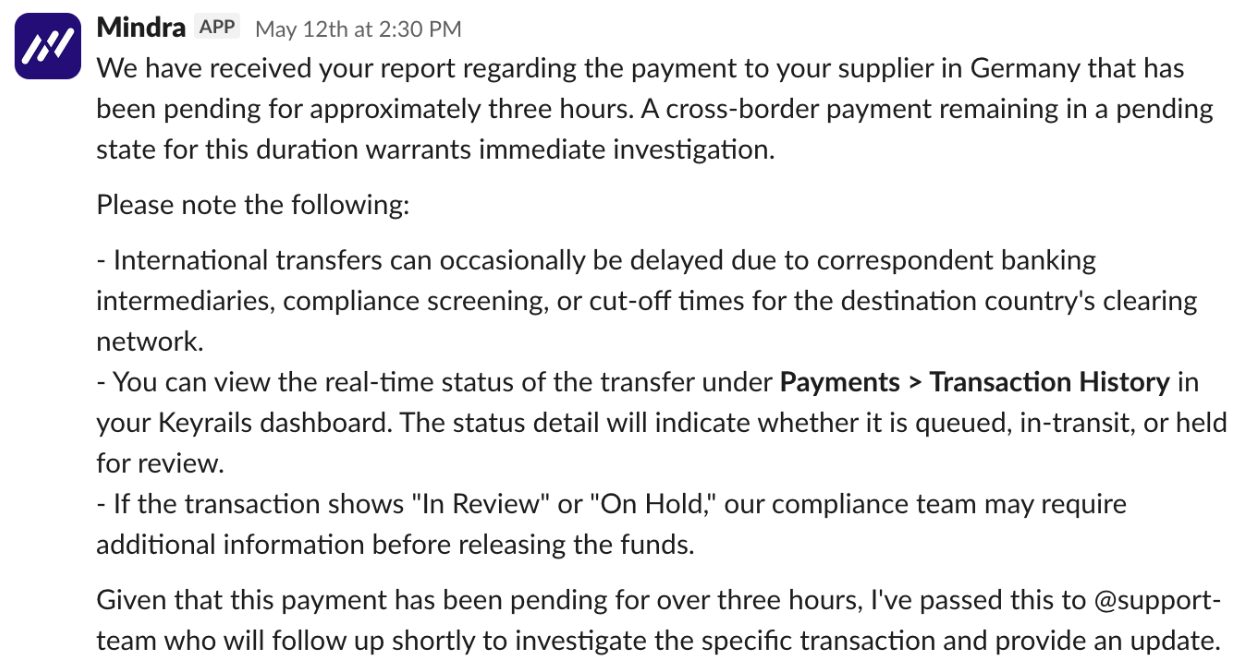 A Mindra-drafted support reply, queued for human approval — careful by design, with no promised timelines or fraud confirmations.
Here's a real example. A customer wrote in about a cross-border supplier payment that had been pending for about three hours. The agent prepared this draft and queued it for approval:
Hi [Name], thanks for flagging this — I can see your payment to the supplier is currently showing as pending.
A quick note on why international transfers sometimes take longer than domestic ones: they often pass through correspondent banking intermediaries, may go through additional compliance screening, and can be affected by cut-off times in the destination country. Any one of those can add a delay.
You can check the real-time status of this payment anytime under Payments > Transaction History. If the status there shows "In Review" or "On Hold," it means our compliance team may need a little more information before it clears.
Since this one has been pending for over three hours, I've passed it to @support-team so a teammate can follow up directly and keep you posted.
Look at what that draft does not do. It doesn't promise the money will arrive by a certain time. It doesn't confirm anything is wrong. It doesn't say compliance will clear it. It explains, points the customer to the source of truth, and escalates — all inside the hard constraints. A human read it and sent it in seconds. That's the model working as designed: careful by default, fast because the careful part is already handled.
Did it actually work? The scoreboard
| Metric | Before | After |
|---|---|---|
| First-response time | 6+ hours | 4 minutes |
| Ticket volume resolved without human escalation | — | 71% |
| Ticket categories automated (human-approved drafts) | 0 | 5 |
| Compliance violations on automated responses | — | 0 |
The four-minute number gets the headlines. The zero gets the renewals.
Why did this work when "AI support" so often doesn't?
Three reasons, and none of them is "the model was smart."
Guardrails came before speed. The team designed what the agent couldn't do before what it could. Three weeks in, zero compliance incidents. That's not luck. It's the direct result of writing the limits down as hard memory constraints on day one, before any ticket touched the system.
Humans stayed in the loop on every word about money. The agent drafts. A person approves. Every customer-facing reply involving an account passed under human eyes before it went out. The AI removed the slow part — the lookup, the personalization, the careful phrasing — without removing the accountability.
It made escalations better, not just fewer. This is the underrated win. The roughly 29% of tickets that still need a human now arrive with a full briefing — account status, recent activity, prior history. So even the hard tickets move faster. The agent didn't just shrink the human's workload. It upgraded it.
There's a full audit trail behind all of it. Every draft, every approval, every fraud-flag routing is logged — which is exactly what a compliance team needs when an auditor asks how an answer was reached.
What's next for the team?
Three expansions, each chosen the same careful way as the first five categories.
- More automated-draft categories, starting with dispute status updates. These are high-volume and compliance-sensitive, but largely templated once a human has triaged the actual fraud claim — so the agent only drafts after a person has done the sensitive judgment.
- A connection to the internal KYC system, so the agent can pre-verify identity-related requests — address changes, beneficiary updates — before they reach a human queue, with the human still making the final call.
- A customer-facing sentiment trend added to the weekly report, so the team sees not just what customers ask about, but how they're feeling about it.
Notice the pattern. Every expansion keeps the human on the sensitive decision and lets the agent handle the repetitive work around it.
Frequently asked questions
Can AI handle fintech support without compliance risk? Yes — if you design the limits first. This fintech defined what the agent could never do (issue refunds, confirm fraud, promise timelines) and saved those as hard constraints before automating anything. The result was zero compliance violations across all automated responses, because the agent drafts replies but a human approves every customer-facing word about money.
How do you keep AI support compliant in fintech? Three things working together: hard guardrails stored in the agent's memory and kept separate from general guidelines; human-in-the-loop approval on every reply involving an account; and a full audit trail of every draft, approval, and escalation. Anything fraud-adjacent bypasses automation entirely and goes straight to a senior human lead.
Should AI auto-send customer support replies? For routine, low-risk questions, an auto-suggested draft can save real time — but in regulated industries like fintech, sending without human review is risky. This team had the agent draft and queue every reply for one-click human approval. Nothing involving money went out unread. The speed came from removing the slow lookup-and-personalize work, not from removing the human.
How does human-in-the-loop approval work for support? The AI agent categorizes each ticket, pulls the customer's real account data, and writes a fully personalized draft. A human reviews it and approves with one click before it sends. Tickets outside the safe categories — especially fraud or disputes — get no draft at all and are routed straight to a person, so automation never touches the sensitive cases.
What's a realistic first-response time with AI support? This fintech went from over 6 hours to 4 minutes for the categories it automated. The gain came from the agent doing the lookup and drafting instantly, leaving the human to simply review and approve — instead of building each reply from scratch.
How do you decide which support tickets are safe to automate? Let the data show you. The team's first instruction was to analyze the last 200 resolved tickets, categorize them, and identify which could be safely handled by a human-approved draft. The agent surfaced five low-risk categories covering 68% of volume — and a human signed off on the list before anything went live.
Where Mindra fits
Mindra lets you hire a whole department of AI agents with a single sentence. The agents act like careful coworkers: they connect to your tools, read your data, take actions, run on schedules, and remember the rules you set — including the hard limits you never want crossed.
For a regulated team, the guardrails are the point. Human-in-the-loop approvals, a full audit trail, RBAC and SSO, SOC 2 Type II and GDPR compliance, and Zero Data Retention when you need it. Model-agnostic, too — Claude, Gemini, GLM, Qwen, or DeepSeek. No engineers required.
If your support queue is mixing routine questions with sensitive ones, and your team is paying for that with hours of first-response time, this is the pattern: define the limits first, keep humans on every reply that touches money, and let the agent handle the careful, repetitive work in between.
See more in our case studies, or read how other teams use Mindra: a food-delivery ops team coordinating 3,000+ restaurant partners with AI agents and an HR system that runs itself — onboarding, policy, and compliance.

Zeynep Yorulmaz
CEO of Mindra
Zeynep Yorulmaz is the Co-Founder & CEO of Mindra, building the platform that lets any team hire a whole department of AI agents with a single prompt.
Stay Updated
Get the latest articles on AI orchestration, multi-agent systems, and automation delivered to your inbox.
Mindra field guide
Read next
Related Articles
How a Mobile Game Studio Turned Competitor Ad Research Into a Live Daily Feed
A 50-person mobile game studio replaced a part-time, hit-or-miss research habit with an AI agent that watches 20+ competitors across four ad networks and delivers a tagged digest every morning.
How a Food Delivery Platform Runs Ops for 3,000+ Restaurant Partners With AI Agents
A national food delivery platform used AI agents to flag failing restaurant partners two weeks early, catch a leaked coupon code in week one, and triage urgent support tickets in minutes.
How a One-Person Consultancy Built a Full CRM Out of AI Agents — and Never Let a Lead Go Cold
An independent B2B operations consultant replaced his messy spreadsheet and willpower-driven follow-ups with a CRM made of AI agents — sourcing, scoring, and nurturing 340+ leads into 6 new client engagements in 5 weeks.
How a Mobile App Kills Losing Ad Campaigns Before They Finish Their First Day
A mobile subscription app used Mindra to predict which ad campaigns would miss CPI in the first 24 hours, auto-pausing waste and cutting losing ad spend 22%.
How a Two-Person HR Team Runs Onboarding, Policy, and Compliance for 150 People With AI Agents
A two-person HR team supporting 150 employees stopped answering the same PTO and policy questions all day. Here is how they put AI agents to work on the routine and kept judgment human.
How a B2B SaaS Team Catches Churn Risk 3 Weeks Before the Cancellation Email
A B2B SaaS team fused Amplitude, Zendesk, and Stripe data with AI agents to score 940 accounts daily, surface real churn signals 3 weeks early, and save 41% of flagged accounts.