How a Food Delivery Platform Runs Ops for 3,000+ Restaurant Partners With AI Agents
A national food delivery platform replaced gut-feel partner monitoring, blanket coupon spend, and a clogged support queue with a team of AI agents that flag problems while they're still fixable.
A national food delivery platform connected its restaurant and driver database, Stripe, and Zendesk to Mindra, then asked AI agents to watch all three every day. The result: failing restaurant partners flagged two weeks before they'd churn, leaked coupon budget caught in week one, and urgent support tickets triaged in minutes instead of hours.
"I used to find out a restaurant partner was failing the moment they called to cancel their contract. Now I find out two weeks before that, while there's still something I can do about it." — Operations lead, national food delivery platform
Key takeaways
- The data already existed; nobody was looking at all of it every day. Mindra's value wasn't new information. It was an analyst who reviews 3,000+ partners, the full driver pool, and the support queue every morning without getting tired.
- Flags came with reasons, not just alerts. Each at-risk restaurant arrived with the specific metric that triggered it and a plausible cause, so a flag became an action item instead of a research project.
- One leaked coupon code was caught in the first week. A 20%-off "win back lapsed customers" promo was being redeemed almost entirely by already-loyal customers. Estimated recovery: $4,200 per week.
- Humans kept control of money and customer-facing words. Coupon recommendations and support replies are suggested, never auto-sent. A person approves anything that touches a refund or a customer.
- Setup took one sentence, not an engineering project. Connect the tools, define three thresholds once, ask a plain-English question. No code.
What were the three operational blind spots?
This platform delivers food across a metro area. Picture 3,000+ restaurant partners and a rotating pool of drivers, all moving at once. Plenty of data flows in. The problem was that nobody had time to read all of it before it turned into a crisis.
Three blind spots kept showing up too late.
Underperforming restaurants, caught by luck. A partner's cancellation rate would creep up. Prep times would slow. Ratings would slide. None of it triggered anything automatic. The team only noticed when a partner manager happened to glance at the right dashboard, or worse, when the restaurant called to cancel its contract.
Coupon spend run on gut feel. Promo codes went out broadly. The intent was to win back lapsed customers or pull in new ones. But a real chunk of the discount budget landed on customers who would have ordered anyway. That's pure margin loss with no behavior change to show for it, and no one had the hours to audit redemption patterns code by code.
A support queue that outran the team. Tickets piled up faster than a small support crew could sort them. An urgent issue, like a wrong order or a missing refund, sat in the same line as a routine "what are your hours" question. For hours. The angriest, most expensive problems weren't getting to the front.
In plain terms: the company was data-rich and attention-poor. The fix wasn't more dashboards. It was someone reliable to actually read them, every single day.
How was the setup configured?
This is the part ops leaders worry about, so here's the honest version. There was no multi-month integration project. There were no engineers writing custom code.
The platform connected Mindra to three sources:
- Its internal restaurant and driver database, via API. (An API is just a secure doorway that lets two systems talk to each other.) This is where performance metrics live.
- Stripe, for payment and refund data. This is how the coupon and margin analysis became possible.
- Zendesk, the support ticket queue.
Mindra connects to 3,000+ tools this way, so most ops stacks plug in without anything custom.
Then the team defined three thresholds, once, and saved them to Mindra's memory so they'd apply every day going forward. Think of memory as the agent remembering your house rules so you never re-explain them.
- A "red flag" restaurant: what counts as a worrying trend on cancellations, prep time, or rating.
- A "red flag" driver: the performance levels that signal a driver is drifting toward deactivation.
- An "urgent" ticket: the signals that push a support ticket to the top.
That's the whole setup. Connect three tools, write down three definitions. Then the first request went in.
What was the first request, and what came back?
The operations lead typed one sentence:
"Look at every restaurant partner's performance over the last 14 days. Flag anyone trending down on cancellation rate, prep time, or rating, and tell me why."
Within minutes, Mindra returned a ranked list of 23 partners. Each one came with the specific metric that drove the flag and a one-line diagnosis. Not "Pasta Palace looks bad," but something a manager could act on:
"Prep time up 40% over 10 days, concentrated in dinner rush; likely a staffing issue, not a menu issue."
That distinction matters. "Staffing issue, not menu issue" tells the partner manager exactly which conversation to have. The agent didn't just point at a problem. It pointed at a probable cause.
Here is a sample of the Daily Restaurant Health Pulse the agent now produces. (Sample output, illustrative names.)
| Restaurant | Risk Level | Driving Metric | One-Line Diagnosis |
|---|---|---|---|
| Pasta Palace | High risk | Prep Time +40% | Staffing bottleneck |
| Pizza Point | High | Cancellation Rate 20% | Out-of-stock items |
| Sushi Sun | Medium | Rating 3.2 | Packaging issue |
Three different problems. Three different fixes. None of them would have surfaced on their own until they got worse.
What did the AI agents actually build?
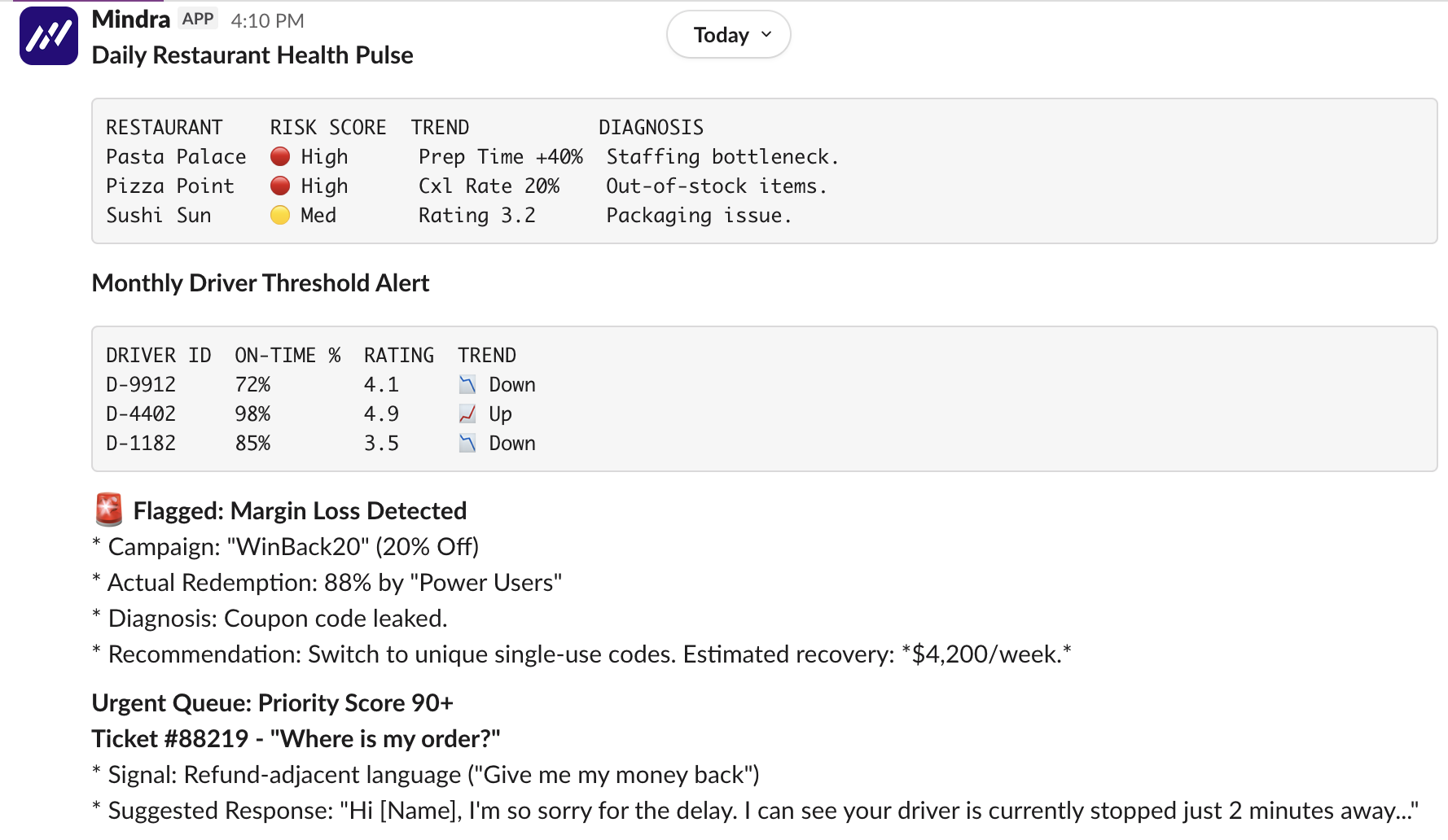 A single morning digest in Slack: restaurant health, driver alerts, coupon margin-loss detection, and the urgent support queue.
From that first request, the team grew a small department of agents. Each one owns a job and runs on its own schedule, like coworkers who never miss a morning.
1. Restaurant health monitor. Every morning, it re-scores all 3,000+ partners against rolling 14-day windows for cancellation rate, prep time, and rating. It posts a ranked "at risk" list to the partnerships Slack channel with the driving metric called out for each one. The partner team starts the day with a prioritized call list instead of a blank dashboard.
2. Driver performance sweep. A parallel workflow scores the driver pool on acceptance rate, on-time delivery, and customer rating. It flags anyone trending toward deactivation thresholds early, while there's still room for a coaching nudge instead of a removal.
Here's a sample Monthly Driver Threshold Alert:
| Driver ID | On-Time Rate | Rating | Trend |
|---|---|---|---|
| D-9912 | 72% | 4.1 | Down |
| D-4402 | 98% | 4.9 | Up |
| D-1182 | 85% | 3.5 | Down |
D-9912 and D-1182 are heading the wrong way. The platform now sees that early, not after a wave of bad deliveries.
3. Coupon allocation agent. This one pulls order history segmented by cohort (new, lapsed, frequent), cross-references redemption rates by coupon type, and recommends which segments should get which offers each week, instead of a blanket promo for everyone.
In its very first week, it caught something the team had been bleeding on quietly:
Margin Loss Detected Campaign: "WinBack20" (20% off, meant for lapsed customers) Actual redemption: 88% by "Power Users" (already-loyal, frequent buyers) Diagnosis: coupon code leaked / shared publicly Recommendation: switch to unique single-use codes Estimated recovery: $4,200 / week
The promo was supposed to win back people who'd drifted away. Instead, frequent customers who would have ordered anyway were eating the discount. No new behavior, all cost. The agent didn't just flag it; it recommended the fix (single-use codes) and put a dollar figure on the leak.
4. Support triage layer. Incoming Zendesk tickets get re-ranked by urgency signal: refund-adjacent language, repeated contact from the same person, an order currently in progress. The top tier routes to a dedicated Slack channel with a suggested first response already drafted for a human to approve and send.
Urgent Queue — Priority 90+ Ticket #88219: "Where is my order?" Signal: refund-adjacent language ("Give me my money back"), order in progress Suggested response: drafted, awaiting human approval
The wrong-order, where's-my-refund tickets now jump the line. The "what are your hours" tickets wait their turn. The team's scarce attention finally lands where it's most expensive to ignore.
Before vs after: what changed?
| Before Mindra | After Mindra | |
|---|---|---|
| Restaurant monitoring | Caught when a manager noticed, or at cancellation | Re-scored daily; flagged ~2 weeks before churn |
| Failing-partner diagnosis | "Something's wrong, dig in" | Driving metric + likely cause attached |
| Driver oversight | Reactive, near deactivation | Early trend flags before threshold breach |
| Coupon spend | Blanket promos, gut feel | Segment-targeted; leaked code caught week 1 |
| Support queue | One line, urgent buried for hours | Re-ranked by urgency; top tier triaged in minutes |
| Who's watching the data | Whoever had time | A consistent agent, every morning |
Why did this work when dashboards didn't?
The platform already had dashboards. So what made agents different?
It surfaced problems while they were still small. The data existed all along. The missing piece was someone actually looking at all of it, every day, without skipping the boring 2,950 partners to get to the dramatic 50. An agent doesn't get tired, doesn't have a busy week, doesn't forget.
It explained, it didn't just alert. A flag with no cause is homework. The agent attaches the driving metric and a plausible reason, which turns a flag into a decision. "Prep time up 40%, concentrated in dinner rush, likely staffing" is something a partner manager can act on before lunch.
It respected the chain of approval. This is the part that made ops leaders comfortable. Coupon recommendations and support replies are suggested, never auto-sent. Humans keep control over anything that moves money or speaks to a customer. The agent does the watching and the drafting. The person does the deciding. That's human-in-the-loop, and it's why the system could be trusted with refunds and customer-facing language from day one.
Frequently asked questions
How can AI flag underperforming restaurant partners before they churn? Connect your partner performance data and define what "at risk" means once (rising cancellation rate, slower prep time, falling rating). An AI agent then re-scores every partner daily against a rolling window and surfaces a ranked list with the specific metric driving each flag. Because it runs every morning, it catches downward trends early, often around two weeks before a partner would otherwise reach the point of canceling.
How do you predict restaurant partner churn? You don't need a complex model to start. Most early churn shows up as a trend: cancellations creeping up, prep times slipping, ratings sliding over a 14-day window. The hard part has always been consistently watching all of it across thousands of partners. An AI agent does that watch daily and attaches a likely cause to each flag, so your team can intervene while the relationship is still recoverable.
Can AI triage customer support tickets? Yes. An AI agent reads each incoming ticket and re-ranks the queue by urgency signals such as refund-adjacent language, repeated contact from the same customer, and whether an order is currently in progress. The most urgent tickets route to a dedicated channel with a suggested first response drafted for a human to review. Routine questions wait their turn. Urgent issues that used to sit for hours get handled in minutes, with a person still approving anything customer-facing.
How do you allocate coupon budget by customer segment? Instead of one blanket promo, an AI agent pulls order history segmented by cohort (new, lapsed, frequent), checks redemption rates by coupon type, and recommends which offer goes to which segment each week. It also catches waste, like a "win back lapsed customers" code being redeemed mostly by already-loyal frequent buyers, which is margin loss with no behavior change. In one case this surfaced an estimated $4,200 per week of recoverable spend in the first week.
Will AI agents take actions without human approval? Not for anything sensitive. With Mindra, decisions that touch money or speak to customers, like coupon changes and support replies, are suggested, not sent. A human approves them. The agents handle the constant monitoring, scoring, and drafting; people keep control over the final call. There's also a full audit trail, RBAC, and SSO, so you can see exactly what each agent did and limit who can do what.
Do I need engineers to set this up? No. You connect your tools (Mindra supports 3,000+ integrations like internal databases via API, Stripe, and Zendesk), define your thresholds once in plain language, and ask for what you want in a sentence. The food delivery platform's first working agent came from a single request: "Look at every restaurant partner's performance over the last 14 days. Flag anyone trending down, and tell me why."
Where Mindra fits
If your ops team is data-rich and attention-poor, Mindra is the coworker who reads everything every morning so you don't have to. Hire a whole department of AI agents with a single sentence. They connect to your tools, read your data, run on schedules, keep a memory of your rules, and suggest actions for a human to approve. It's model-agnostic (Claude, Gemini, GLM, Qwen, DeepSeek), SOC 2 Type II and GDPR compliant, with Zero Data Retention available, full audit trail, RBAC, and SSO. No engineers required.
See more results across industries on our case studies page, or read two related stories: how a fintech cut support first-response time from 6 hours to 4 minutes, and how a SaaS company caught churn risk three weeks before cancellation.
Ready to put an ops analyst that never sleeps on your restaurant, driver, and support data? Book a demo.

Zeynep Yorulmaz
CEO of Mindra
Zeynep Yorulmaz is the Co-Founder & CEO of Mindra, building the platform that lets any team hire a whole department of AI agents with a single prompt.
Stay Updated
Get the latest articles on AI orchestration, multi-agent systems, and automation delivered to your inbox.
Mindra field guide
Read next
Related Articles
How a Mobile Game Studio Turned Competitor Ad Research Into a Live Daily Feed
A 50-person mobile game studio replaced a part-time, hit-or-miss research habit with an AI agent that watches 20+ competitors across four ad networks and delivers a tagged digest every morning.
How a Fintech Cut First-Response Time From 6 Hours to 4 Minutes — Without Lowering the Compliance Bar
A five-person support team was buried in tickets mixing routine questions with sensitive ones. By building an AI support agent around guardrails first, this fintech hit 4-minute first responses and zero compliance violations.
How a One-Person Consultancy Built a Full CRM Out of AI Agents — and Never Let a Lead Go Cold
An independent B2B operations consultant replaced his messy spreadsheet and willpower-driven follow-ups with a CRM made of AI agents — sourcing, scoring, and nurturing 340+ leads into 6 new client engagements in 5 weeks.
How a Mobile App Kills Losing Ad Campaigns Before They Finish Their First Day
A mobile subscription app used Mindra to predict which ad campaigns would miss CPI in the first 24 hours, auto-pausing waste and cutting losing ad spend 22%.
How a Two-Person HR Team Runs Onboarding, Policy, and Compliance for 150 People With AI Agents
A two-person HR team supporting 150 employees stopped answering the same PTO and policy questions all day. Here is how they put AI agents to work on the routine and kept judgment human.
How a B2B SaaS Team Catches Churn Risk 3 Weeks Before the Cancellation Email
A B2B SaaS team fused Amplitude, Zendesk, and Stripe data with AI agents to score 940 accounts daily, surface real churn signals 3 weeks early, and save 41% of flagged accounts.