How a One-Person Consultancy Built a Full CRM Out of AI Agents — and Never Let a Lead Go Cold
An independent B2B operations consultant stopped running his pipeline on memory and willpower — and let a team of AI agents source, score, and follow up instead.
A solo operations consultant replaced his spreadsheet-and-memory pipeline with a CRM made of AI agents: they sourced 340+ leads, ran personalized outreach in his voice, and chased every follow-up automatically — turning into 6 new client engagements in 5 weeks. The system did the unglamorous, compounding work he never had time for.
Key takeaways
- The work was never the bottleneck — the pipeline was. A one-person business can only do one thing at a time. Consulting work kept winning, so follow-ups kept losing.
- He didn't buy CRM software. He described his ideal client in plain language and saved it as a standing profile in Mindra's memory — a CRM made of conversation, not software.
- AI agents acted like a tireless sales assistant: sourcing new leads weekly, scoring them by fit, writing personalized first-touch emails, and firing day-4, day-9, and day-21 follow-ups automatically.
- It kept his voice. Mindra learned his actual writing patterns from emails he'd already sent, so drafts read like a human wrote them — part of why replies kept coming.
- The scoreboard: 340+ leads sourced and scored, 89 qualifying conversations, a 31% reply rate on first-touch outreach, and 6 signed engagements in 5 weeks.
- Human-in-the-loop, not autopilot. Mindra drafted the next message for approval rather than sending blind — judgment stayed with the consultant.
What was the actual problem — a pipeline that lived in his head?
He runs a solo operations-consulting practice. He advises small manufacturing and logistics companies on process improvement — the kind of work where one good engagement leads to the next by referral.
The consulting itself was never the bottleneck. Finding and nurturing the pipeline was.
Leads came from three places: referrals, LinkedIn conversations, and the occasional inbound message. And they lived in three places too — in his head, in a messy spreadsheet, and in whichever email thread he happened to remember. There was no single place that answered the only question that mattered: who do I need to follow up with, and when?
That gap had a cost. Following up consistently is the unglamorous, compounding work that actually closes business. It also has no deadline of its own, so it always lost. A client deadline on Tuesday beat a day-9 follow-up every single time.
So leads went quiet. Not because they weren't interested — because nobody followed up on day 4, day 9, or day 21. The interest was real. The system to act on it didn't exist.
He didn't need more leads, exactly. He needed something that would never forget one.
How do you build a CRM without buying CRM software?
He started somewhere most people wouldn't expect: he didn't buy CRM software at all.
Instead, he built a CRM made of conversation, not software. Here's what that meant in practice.
First, he described his ideal client in plain language — company size, industry, and the pain signals that suggest a company is about to need help: recent headcount growth, a new operations leader, an open ops or supply-chain role. He saved that description as a standing profile in Mindra's memory. From then on, every agent referenced the same definition of "a good lead."
Then he connected the tools he already used. No migration. No new login for the team (there is no team).
| Tool | Role in the system |
|---|---|
| Gmail | Outreach and replies — Mindra reads incoming responses and drafts the next message |
| Browser automation | LinkedIn research — pulling company signals, leadership changes, and open roles |
| A Google Sheet | The system of record Mindra reads from and writes to, instead of dedicated CRM software |
Mindra connects to 3,000+ tools, so the stack could grow later. But this was enough to start.
Then came the first prompt — written the way you'd ask a capable new hire:
"Find me 50 manufacturing companies in Houston with 20–150 employees that have posted an operations or supply chain job in the last 60 days. Score them by fit and tell me why."
Mindra returned a scored list with a one-line rationale for each company. That last part is the important one. The "tell me why" turned a list into judgment — the kind of judgment call that used to eat a full afternoon of manual LinkedIn searching.
Here's the shape of what came back:
| Company | Fit score | Signal | Why it scored |
|---|---|---|---|
| Houston Precision | 9 / 10 | Open Director of Operations role + recent expansion | Leadership gap during growth is peak need for ops help |
| Bayou Logistics Co. | 8 / 10 | Posted 2 supply-chain roles in 30 days | Scaling fulfillment, likely process strain |
| Gulf Coast Fabrication | 7 / 10 | Headcount up ~20% YoY | Growth without process usually means firefighting |
| Lone Star Components | 5 / 10 | Stable headcount, no open roles | No active signal — park and re-check next cycle |
What did the agents actually build?
What started as one prompt became a four-part system — a small department of AI agents, each owning a stage of the pipeline.
1. The sourcing agent. Weekly, it re-runs the ideal-client profile against fresh criteria: new job postings, leadership changes, funding announcements in adjacent industries. It adds newly qualified leads to the sheet — pre-scored and de-duplicated against everyone already in the pipeline. He wakes up to new, ranked leads without lifting a finger.
2. The qualification email sequence. Each new lead gets a personalized first-touch email referencing the specific signal that surfaced them — the job posting, the leadership hire — not a generic template. When replies come in, Mindra reads and classifies them: interested / not now / not relevant. Then it drafts the next message for approval rather than sending fully autonomously. He stays in the loop on every reply that matters.
3. The follow-up cadence. Every lead that doesn't reply gets a scheduled second and third touch at intervals that fire automatically. This is the part that used to lose to client deadlines — now it just happens. The sheet shows at a glance where every lead sits.
4. The qualifying-call brief. When a lead replies with real interest, Mindra compiles everything known about the company — the original signal, the LinkedIn research, the prior email exchange — into a one-page brief before the call. He walks in prepared every time, without prepping.
Here's the kind of first-touch email it drafted — short, specific, in his voice:
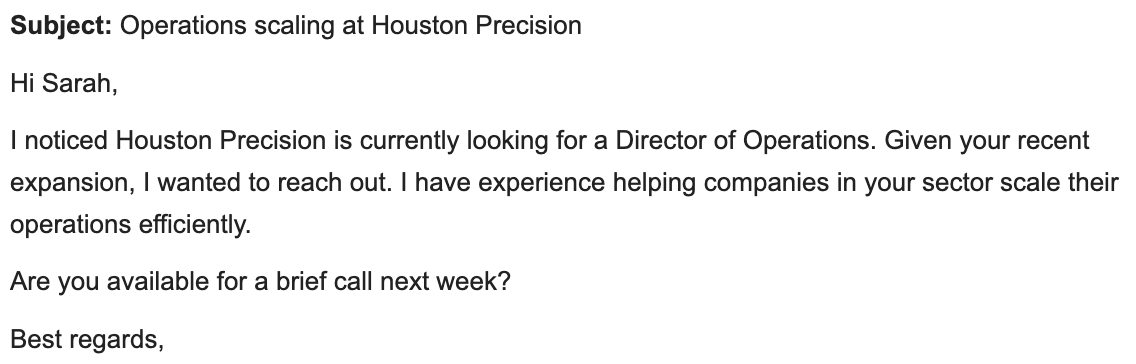 A first-touch email Mindra drafted in the consultant's own voice, referencing the exact signal that surfaced the lead.
Subject: Operations scaling at Houston Precision
Hi Sarah,
I noticed Houston Precision is currently looking for a Director of Operations. Given your recent expansion, I wanted to reach out. I have experience helping companies in your sector scale their operations efficiently.
Are you available for a brief call next week?
Best regards,
No "I hope this email finds you well." Just a real observation and a clear ask.
Why did it work when a spreadsheet didn't?
Three reasons, and none of them is "AI is magic."
It replaced willpower with a system. The discipline that used to live in his memory — remember to follow up on day 9 — now lives in something that runs on its own. He's no longer the single point of failure for his own pipeline.
It kept his voice. Mindra learned his actual writing patterns from emails he'd already sent. The drafts read like a human wrote them, because the patterns came from a human. That's not a cosmetic detail — it's part of why replies kept coming. Prospects reply to people, not to templates.
It scaled the unscalable part. A one-person business can do exactly one thing at a time. While he did the consulting work that pays the bills, Mindra kept the pipeline moving in the background — sourcing, emailing, following up. The bottleneck wasn't removed by working harder. It was removed by running two things at once.
| Manual pipeline (before) | Mindra-run pipeline (after) | |
|---|---|---|
| Lead sourcing | An afternoon of LinkedIn searching, occasionally | Weekly, automatic, pre-scored and de-duplicated |
| System of record | Head + messy spreadsheet + email threads | One Google Sheet, always current |
| First-touch outreach | Whenever he remembered | Personalized to each signal, drafted automatically |
| Follow-ups (day 4 / 9 / 21) | Lost to client deadlines | Scheduled, fired automatically |
| Reply handling | Buried in the inbox | Read, classified, next message drafted for approval |
| Call prep | Scramble before the call | One-page brief compiled in advance |
What does the scoreboard say?
Five weeks in, the first-party numbers:
- 340+ leads sourced and scored against a standing ideal-client profile
- 89 qualifying conversations carried through email sequencing
- 31% reply rate on first-touch outreach
- 6 new client engagements signed in 5 weeks — sourced entirely through the system
A 31% reply rate on cold-ish outreach is not a template number. It's what happens when every message references a real signal and reads like a person wrote it.
What's next for the system?
Two expansions are already in motion.
Wider sourcing. Beyond LinkedIn, the same ideal-client profile and scoring logic will run against industry-specific directories, conference attendee lists, and local Chamber of Commerce listings. Same brain, more places to look.
Self-scheduling. Connecting Calendly so qualified leads can book the first call themselves the moment Mindra classifies them as "interested" — closing the last manual gap between a warm reply and a calendar slot.
The pattern holds: describe what you want once, let the agents run it forever.
Frequently asked questions
Can AI agents replace a CRM for a solo founder? For many solo founders and consultants, yes. Instead of buying CRM software, you describe your ideal client in plain language, save it as a standing profile, and let AI agents source, score, and nurture leads using tools you already have — like Gmail and a Google Sheet as the system of record. The agents handle the follow-up discipline a CRM only reminds you to do yourself.
How can a solo consultant automate lead generation? Start by describing your ideal client — company size, industry, and pain signals like recent headcount growth, a leadership change, or a relevant open role. With Mindra, you save that as memory and a sourcing agent re-runs it weekly against fresh data, adding pre-scored, de-duplicated leads to your spreadsheet automatically. No engineers and no manual LinkedIn searching required.
Can AI write personalized cold outreach that gets replies? Yes, when it references a specific signal instead of a generic template. In this case, each first-touch email named the exact reason the lead surfaced — an open Director of Operations role, a recent expansion — and was written in the consultant's own voice, which Mindra learned from his past emails. The result was a 31% reply rate.
How do you automate sales follow-up sequences without a CRM? Set a cadence and let it fire on schedule. Every lead that doesn't reply gets a scheduled second and third touch at fixed intervals — the day-4, day-9, and day-21 follow-ups that usually lose to other deadlines. Mindra runs them in the background and updates the shared sheet so you can see where every lead sits at a glance.
Is the AI sending emails on its own, or do I stay in control? You stay in control. Mindra reads and classifies replies — interested, not now, not relevant — then drafts the next message for your approval rather than sending fully autonomously. With human-in-the-loop approvals, a full audit trail, SOC 2 Type II and GDPR compliance, and Zero Data Retention available, the judgment stays with you.
How long does it take to see results? This consultant saw 6 signed engagements in 5 weeks from 340+ sourced leads. Because the setup is conversation, not configuration — describe your ideal client, connect your tools, write the first prompt — most of the work is live within the first session.
Where Mindra fits
Mindra lets you hire a whole department of AI agents with a single sentence. The agents act like coworkers: they connect to your tools (3,000+ integrations), read your data, take actions, run on schedules, and keep a memory of what matters. They're model-agnostic (Claude, Gemini, GLM, Qwen, DeepSeek), SOC 2 Type II and GDPR compliant, with human-in-the-loop approvals and a full audit trail. No engineers required.
For a solo founder or a small B2B sales team, that means the compounding work — sourcing, scoring, following up — finally runs on its own.
See more real-world results in our case studies, or read how other teams put agents to work:

Zeynep Yorulmaz
CEO of Mindra
Zeynep Yorulmaz is the Co-Founder & CEO of Mindra, building the platform that lets any team hire a whole department of AI agents with a single prompt.
Stay Updated
Get the latest articles on AI orchestration, multi-agent systems, and automation delivered to your inbox.
Mindra field guide
Read next
Related Articles
How a Mobile Game Studio Turned Competitor Ad Research Into a Live Daily Feed
A 50-person mobile game studio replaced a part-time, hit-or-miss research habit with an AI agent that watches 20+ competitors across four ad networks and delivers a tagged digest every morning.
How a Food Delivery Platform Runs Ops for 3,000+ Restaurant Partners With AI Agents
A national food delivery platform used AI agents to flag failing restaurant partners two weeks early, catch a leaked coupon code in week one, and triage urgent support tickets in minutes.
How a Fintech Cut First-Response Time From 6 Hours to 4 Minutes — Without Lowering the Compliance Bar
A five-person support team was buried in tickets mixing routine questions with sensitive ones. By building an AI support agent around guardrails first, this fintech hit 4-minute first responses and zero compliance violations.
How a Mobile App Kills Losing Ad Campaigns Before They Finish Their First Day
A mobile subscription app used Mindra to predict which ad campaigns would miss CPI in the first 24 hours, auto-pausing waste and cutting losing ad spend 22%.
How a Two-Person HR Team Runs Onboarding, Policy, and Compliance for 150 People With AI Agents
A two-person HR team supporting 150 employees stopped answering the same PTO and policy questions all day. Here is how they put AI agents to work on the routine and kept judgment human.
How a B2B SaaS Team Catches Churn Risk 3 Weeks Before the Cancellation Email
A B2B SaaS team fused Amplitude, Zendesk, and Stripe data with AI agents to score 940 accounts daily, surface real churn signals 3 weeks early, and save 41% of flagged accounts.